
Insight
The other World Cup: what a week at the Gothia Cup taught us about the real value of youth football
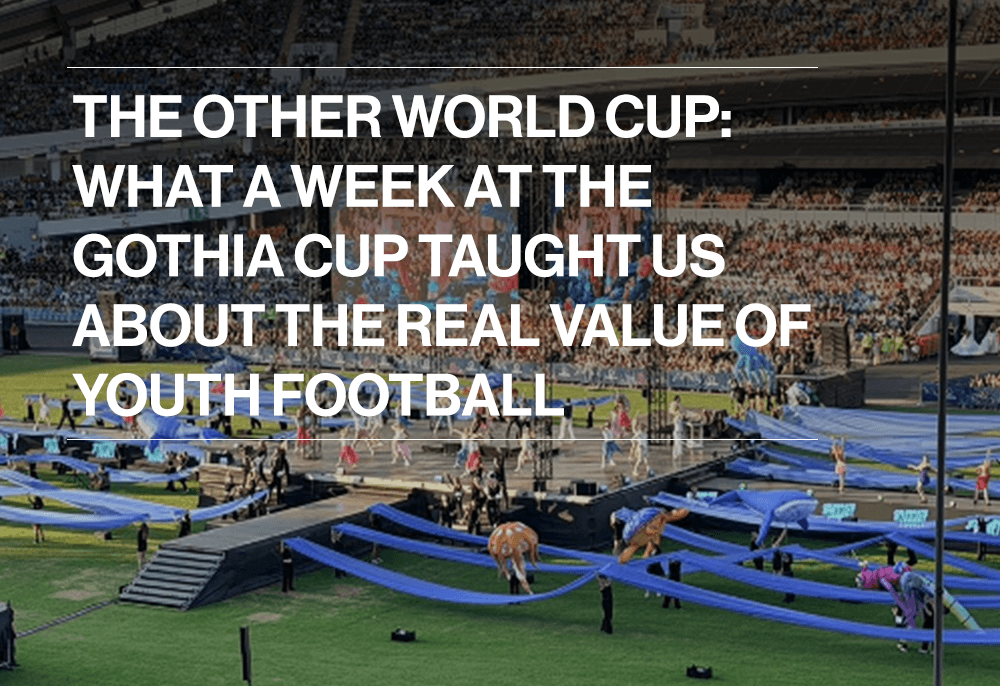
This summer, while much of the world was watching the FIFA World Cup unfold across the United States, Mexico and Canada, my family and I were at a different World Cup. It rarely troubles the back pages, yet in sheer scale it makes the senior tournament look almost modest. In Gothenburg, Sweden, the Gothia Cup, fittingly billed as “the World Youth Cup”, was doing what it has done every July since 1975: turning a single Nordic city into the beating heart of world football for one extraordinary week.
I was there as a parent, and both of our children were playing. But I spend my working life thinking about the commercial value of sport, and it proved impossible to come home without a few professional reflections packed in alongside the muddy kit.
The scale of the Gothia Cup, the world’s biggest youth football tournament
The numbers from the 2026 edition are staggering. 1,956 teams from 78 nations. Around 45,300 players and team officials. Roughly 4,900 matches, across 124 pitches, all inside a single week. For comparison, the FIFA World Cup this summer featured 48 teams and 104 matches. On participation, the “small” tournament wins many times over.
This is not a recent spike. The Gothia Cup has been staged every year since 1975, this year for the 51st time, and in that time well over a million young players, from around 150 nations, have taken part. The week generates close to a billion Swedish kronor for the host region. But the figure that stayed with me is a different one: 46% of its 2,600 volunteers are nineteen or younger. This is a tournament run substantially by young people, for young people.
On participation, the “small” tournament wins many times over: 1,956 teams to the World Cup’s 48.
Why Gothia Cup youth football is the foundation, not the footnote
It is easy, in the commercial conversations I’m usually part of, to treat grassroots sport as the sentimental end of the business: worthy, but peripheral to where the money and the attention sit. A week in Gothenburg is a useful corrective. Every elite pyramid rests on a base this wide. The Gothia Cup’s alumni board reads like a who’s-who. Zlatan Ibrahimović, Andrea Pirlo, Xabi Alonso and Alan Shearer are among those who appeared here as boys. But the vast majority of the 45,000 who take part each year will never turn professional, and that is precisely the point. What’s on offer is not a production line for future stars. It is participation, belonging and experience, delivered at a scale almost nothing else in sport can match.

For most of the 45,000 who play, the value isn’t a professional contract; it’s the experience itself.
What a week like this builds in a young person
Watching it up close, the developmental case makes itself. Over a week, children navigate a foreign country, share a school-hall dormitory with their team, win and lose in front of real crowds, and line up against opponents whose language they don’t speak and whose football looks nothing like their own. Our two teams were sides from the Prep Schools’ Lions, a selection programme in southern England. Between them, they faced opponents from eight countries in seven days: Sweden, Poland, Mexico, the UAE, Tunisia, the USA, Spain and Latvia. The 78-nation melting pot, in miniature.
The boys battled through to the Plate semi-finals; the girls came through their group unbeaten. But the results, honestly, were the least of it. The independence, the resilience and the sheer breadth of the experience are the kind of growing-up that no classroom delivers.

Two of our very own Prep Schools’ Lions sides made the trip to Gothenburg.
A model worth noticing
The route our children travelled there is itself worth a look. The Prep Schools’ Lions draw talented players from more than a hundred schools, select squads by age group, and build a season around Easter training camps (complete with sports scientists and FA psychologists) and fixtures against professional academies, with the Gothia Cup as the flagship trip of the year. For anyone who thinks about sport structurally, it is a neat example of how fragmented, informal youth football can be organised into a coherent, fundable pathway: one that develops players, certainly, but also creates a genuine programme with its own identity, community and, potentially, commercial value.
The commercial lens
Which brings me back to the day job. There is a serious commercial argument hiding inside all this warmth. Grassroots and youth football represent an enormous, values-rich and, I would argue, systematically under-valued space for brands, rights-holders and sponsors. The audience is global, engaged and family-shaped; the associations are overwhelmingly positive; and the scale, as Gothenburg demonstrates, is entirely real. As the elite game becomes more analytically level and, in turn, less predictable, the parts of the sport built on participation and story rather than star power start to look more attractive, not less. Models like the Prep Schools’ Lions hint at how that value might be structured and captured, rather than left on the table.
None of this requires pretending a youth tournament is a Champions League final. It requires recognising that a better, more serious youth experience is a better asset: for the children who live it, and for the partners thoughtful enough to invest in it.
And yes (occupational hazard), I turned our own week into a spreadsheet: fourteen matches across eight venues, and the better part of 160 kilometres criss-crossing Gothenburg to make every kick-off. Analysing sport for a living, it turns out, is difficult to switch off.
The Gothia Cup gave some of the game’s greatest names an early stage. For the 45,000 children who played this year, it gave something simpler and more durable: the memory of playing football at a World Cup of their very own. The numbers are staggering, but the real return sits in those memories, and in the quietly enormous machine that makes them possible. For anyone serious about the future of sport, Gothia Cup youth football is worth paying attention to.
Related Read: What the 2026 World Cup is quietly telling us about the commercial future of sport
Maria Walsh | Platformation Enterprise Services
Platformation Enterprise Services Limited is a specialist sponsorship valuation agency, ISO 9001:2015 certified (Certificate No. GB2006233). The only sponsorship valuation agency, to our knowledge, whose methodology has been tested in a court of law.
platformation.global
You may also like...

Golf Sponsorship: What the Numbers Actually Show
Golf reaches a bigger, wealthier and more commercially useful audience than most brands assume. The harder question isn’t whether to be in the sport. It’s…
SDMS 2026: The Full Picture
About the sponsorship decision maker survey Five findings from the Sponsorship Decision Maker Survey 2026. Seen together, they describe a market that has decided where…

What Are You Actually Buying When You Commission a Sponsorship Valuation?
Sponsorship valuation is our flagship service. We’ve done it for years, at the highest levels of the industry, for some of the most consequential partnerships…

What the 2026 World Cup is quietly telling us about the commercial future of sport
Amongst all the noise surrounding this year’s World Cup, with its naming rights controversies, hydration break furore and geopolitical fault lines, two rather quieter stories…
Platformation did a great job for MarkSetBot on this project. It really helped launch both our marketing and fundraising efforts. We highly recommend them!
Matthew Morin
A valuable partner offering constructive input and innovation from across the world of football and beyond.
Petr Zascherinsky
Platformation have provided great insight and recommendations across our broad, diverse portfolio of events and content.
Walter Böhm
Andrew’s experience and understanding of the field offered great confidence and the rigour they applied to such a complex challenge was best in class.
Fiona Fletcher-Smith
Andrew and his international network of suppliers delivered a comprehensive set of valuable insights.
Simon Thomas
Resourceful and skilled, with a fantastic network and incredible experience. A valued and trusted business partner.
David Sim
Our Services
We support organisations at different stages of the sponsorship lifecycle, from understanding value to applying insight in practice. Each service addresses a specific question, while together they provide a clear, connected view of sponsorship performance.