
Insight
What the 2026 World Cup is quietly telling us about the commercial future of sport
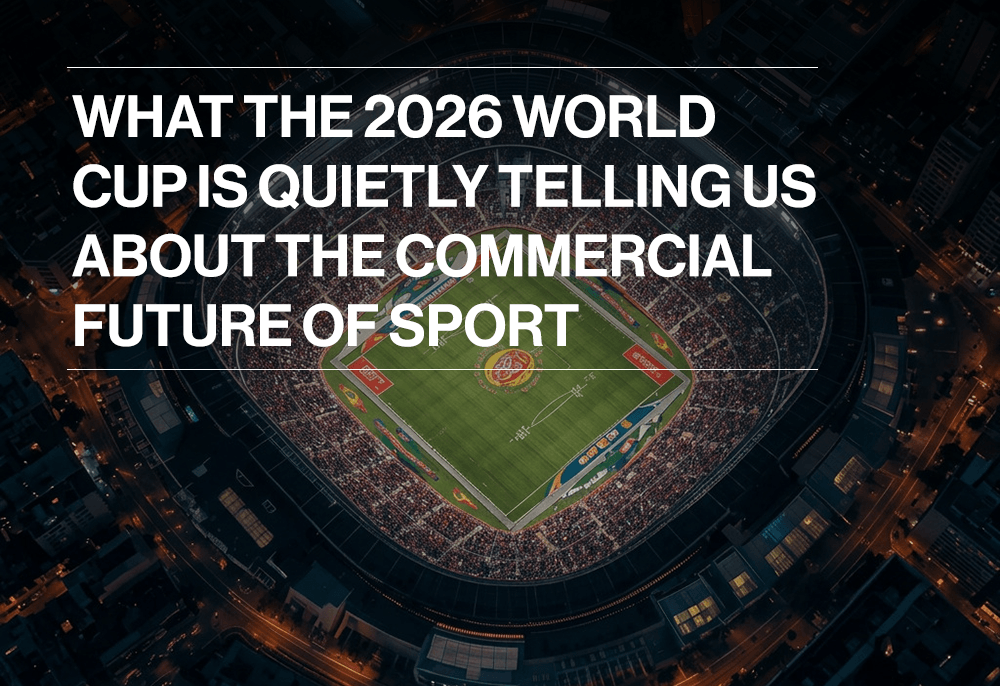
Amongst all the noise surrounding this year’s World Cup, with its naming rights controversies, hydration break furore and geopolitical fault lines, two rather quieter stories deserve more attention from anyone who works in, or invests in, the business of sport.
Neither will generate many back-page headlines. But taken together, they point towards something significant: a sport beginning, however tentatively, to take its own product quality seriously.
The first is about data. For the 2026 tournament, FIFA partnered with Lenovo to give every one of the 48 participating teams access to Football AI Pro, a generative AI analytics platform built on FIFA’s own football language model. Coaches can ask it questions in plain language about opponent tendencies, set-piece patterns and pressing triggers. It reconstructs matches in three dimensions and processes hundreds of millions of data points per game, returning answers quickly enough to be useful in a team meeting rather than merely a post-mortem.
None of that, on its own, is particularly surprising. Elite clubs and well-resourced national federations have been building analytical infrastructure of this kind for years. What is notable is that FIFA made it available to all 48 teams equally, including tournament debutants such as Curaçao and Cabo Verde, who arrived in North America with the same analytical intelligence at their disposal as Germany or Argentina.

Video analysis software is now a common tool across elite football squads
This is not a small thing. Sport at the highest level has long been stratified not just by talent and investment but by access to information. The ability to understand an opponent in forensic detail, to identify structural weaknesses and to prepare players for specific scenarios has historically been a competitive advantage available primarily to those who could afford it. FIFA’s decision to make it a common resource is, in effect, an attempt to separate preparation from budget.
Whether it will reshape competitive outcomes over time is genuinely interesting to watch. This tournament has already produced some striking results from nations that, in previous editions, would simply have been grateful to qualify. The causal chain is difficult to isolate, with more teams, different conditions and natural variance all playing a role. But the principle matters regardless of what the results alone tell us: that the sport has acknowledged an imbalance in access to intelligence and chosen to address it at the tournament level.
For those of us who work in sponsorship and commercial sport, this raises a question worth sitting with. If analytical levelling does make outcomes less predictable, if the gap between a well-resourced European giant and a well-prepared smaller nation genuinely narrows, what does that do to the commercial architecture of the sport? Rights holders and sponsors have long structured their investments around the assumption that certain names, certain matchups and certain narratives are bankable. A more genuinely competitive global game is a more interesting one. Whether it is also a more commercially legible one is a different conversation.
The second story is more immediately tangible, and its implications for sponsors are fairly direct.
IFAB introduced a set of anti-time-wasting measures for this tournament: a visible 10-second substitution countdown, with a one-minute delay penalty for non-compliance; a five-second hand-countdown for goal kicks and throw-ins in situations of deliberate delay; and a requirement that players receiving treatment leave the pitch for at least a minute before returning. Simple rules, transparently enforced.

The 10-second substitution countdown is now a visible, transparent standard
The effect has been measurable. Average match duration has fallen from 102 minutes and 43 seconds at Qatar 2022 to 96 minutes and 8 seconds here. More tellingly, 59.4% of total match time at this tournament consists of live football, the highest figure recorded across the last three World Cups. FIFA itself had set 60 minutes of ball-in-play time as a target. It very nearly got there.

Average match duration fell by more than six minutes between Qatar 2022 and 2026
For anyone in the business of sponsorship, that second figure matters more than the first. The length of a match is largely irrelevant to commercial value. What matters is the quality and character of the time: how much of a broadcast window is actually occupied by the sport itself, rather than by stoppages, delays and the various theatrical performances that have accumulated over decades of elite football.
Sponsorship fees are justified by reach and frequency, but the honest question that rarely gets asked is what those impressions are actually worth during periods of manufactured inactivity. A brand visible on screen during 60 minutes of flowing, competitive football is not the same proposition as the same brand during a six-minute stoppage while a player receives treatment for a knock that apparently healed itself the moment the ball was about to be restarted. The rules introduced for this tournament are beginning, at least, to close that gap.
What connects these two stories is not technology, or regulation, or any particular governance initiative. What connects them is intent: a signal, however tentative, that those responsible for the product are paying attention to its quality rather than merely its scale.
That distinction matters enormously in a moment when the sport is expanding aggressively: more teams, more matches, more tournaments, more revenue. Expansion and quality are not inherently in conflict. But they do require active management. The 2026 World Cup, whatever its controversies, has offered at least two demonstrations that the sport can move in the right direction when it chooses to.

At Platformation, we spend a lot of time thinking about what sponsors and commercial partners actually value in the properties they invest in and how well those properties understand and serve their commercial relationships. Greater analytical equity and measurably more live football are precisely the kind of structural improvements that translate into stronger commercial partnerships and better returns on sponsorship investment. For the commercial and business decision makers working in and around sport, whether in rights sales, partnership management, brand strategy or broadcasting, these are not peripheral observations. They are early indicators of a sport becoming more serious about the quality of the product it is asking people to invest in and the opportunities that follow from that shift are, for those paying attention, considerable.
There is, of course, plenty more to say about this tournament. The treatment meted out to a referee of Somali heritage. The ongoing controversies surrounding the Iranian squad. A newly invented FIFA Peace Prize, awarded by the FIFA president to the sitting US President. A red card famously reversed after what appeared to be a call from the Oval Office. Stadium names buried beneath 65,000 strips of tape applied by hand (though several of the brands concerned appeared to enjoy themselves in the process rather more than FIFA’s branding team had anticipated). And a winners’ ceremony featuring championship rings, a tradition warmly borrowed from sports in which the deliberate use of hands is actively encouraged. All of it is fascinating, much of it is alarming and most of it is entirely deserving of its own article. That one, however, is very much for another day.
Andrew Walsh | Platformation Enterprise Services
You may also like...
Is Strade Bianche Now Cycling’s Sixth Monument?
Global interest in cycling is estimated at 651.7 million with Europe remaining the cultural heartland of cycling. 113.8 million Europeans show an interest in cycling;…
How to define value in modern sponsorship
Boards want evidence. Stakeholders see value differently. Our framework for defining sponsorship value around purpose, performance and efficiency brings clarity before the contract is signed.
Will 2026 be a turning point for Super League’s TV rights?
An in-depth look at the growing gap between Super League and Prem Rugby broadcast valuations, and why market structure, not audience demand, is driving the...

Turning insight into action
Most sponsorship teams have plenty of data. Far fewer have insight that changes decisions. We examine the gap, and more importantly, and how to close...
Platformation did a great job for MarkSetBot on this project. It really helped launch both our marketing and fundraising efforts. We highly recommend them!
Matthew Morin
A valuable partner offering constructive input and innovation from across the world of football and beyond.
Petr Zascherinsky
Platformation have provided great insight and recommendations across our broad, diverse portfolio of events and content.
Walter Böhm
Andrew’s experience and understanding of the field offered great confidence and the rigour they applied to such a complex challenge was best in class.
Fiona Fletcher-Smith
Andrew and his international network of suppliers delivered a comprehensive set of valuable insights.
Simon Thomas
Resourceful and skilled, with a fantastic network and incredible experience. A valued and trusted business partner.
David Sim
Our Services
We support organisations at different stages of the sponsorship lifecycle, from understanding value to applying insight in practice. Each service addresses a specific question, while together they provide a clear, connected view of sponsorship performance.