
Insight
SDMS 2026: The Full Picture
Five findings from the Sponsorship Decision Maker Survey 2026. Seen together, they describe a market that has decided where it’s going.
The Sponsorship Decision Maker Survey is the only longitudinal brand-side study in sponsorship. It has run on a consistent methodology since 2018, across five waves: 2018, 2020, 2022, 2025 and 2026. The 2026 wave, our World Cup Edition, surveyed 204 senior brand-side decision makers in August 2026, across more than 23 countries (SDMS 2026, n=204).
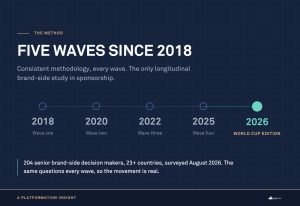
What makes it useful isn’t the size of any single number. It’s that the questions don’t change between waves. That’s what turns a set of results into a trend line, rather than a snapshot. When a figure moves across five waves asked the same way, the movement is real, not an artefact of how the question happened to be framed this time. Here’s what the 2026 data shows, and what it tells you.
Budgets Are Back
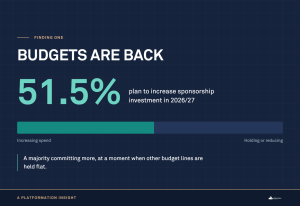
Just over half of senior brand buyers, 51.5%, plan to increase their sponsorship investment in 2026/27. That alone would signal a market in recovery. What sharpens it is the scale of intent behind it: 29.4% plan to raise their spend by more than 20%.
Confidence at this level isn’t a drift back to where things were. It’s a decision to commit more, and to commit it deliberately. A market where a majority are increasing, at a moment when plenty of other budget lines are being held flat or cut, is repricing sponsorship as a channel worth backing. When money moves like this, it doesn’t spread evenly across everything on offer. It moves toward the properties and partners that can show a return.
Women’s Sport Has Arrived
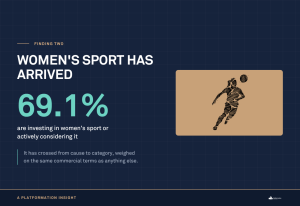
69.1% of buyers are now investing in women’s sport or actively considering it. The growth of women’s sport is well documented, so the number on its own isn’t the story. The threshold it marks is.
Women’s sport has stopped being a values-led gesture. It’s now a mainstream allocation decision.
When roughly seven in ten senior buyers treat women’s sport as a live option, it has crossed from cause to category. It’s no longer something a brand does to signal its values, to be revisited if budget allows. It’s weighed on the same commercial terms as anything else. For rights holders, that changes the conversation from why to how much. For brands still on the fence, the risk has quietly inverted: the question is no longer whether women’s sport is proven, but whether you’re late to it.
The Growth Is Concentrated
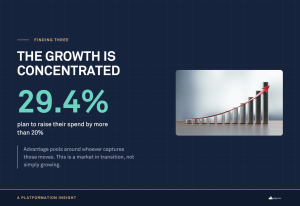
Nearly a third of byers are planning to raise spend by more than 20%, and look at it on its own terms. A market where nearly a third of buyers are making increases of that size isn’t simply growing. It’s in transition.
Broad, modest growth lifts everyone a little. Concentrated growth doesn’t. When a large minority commit significant new money while the rest hold steady, advantage pools around whoever captures those moves. The rights holders and agencies that win the outsized budgets set the terms for the next cycle. Those that read this as an ordinary uptick, and compete the way they did when growth was flat, are left with the smaller half of a market that has quietly split in two.
Measurability Is Now the Baseline
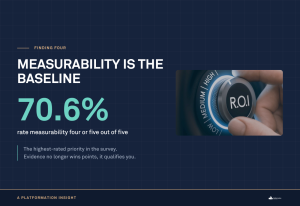
70.6% of senior buyers rate measurability four or five out of five. It is their highest-rated priority across every factor the survey measures. That makes it the sharpest finding in the 2026 wave, and the one with the hardest edge for anyone selling sponsorship.
Measurability isn’t a differentiator any more. It’s the price of being in the room.
For years, robust measurement was a way to stand out. That window has closed. When more than seven in ten buyers rank it at the top, it stops being an advantage and becomes an expectation. The organisations that can put defensible evidence behind a partnership don’t win points for it, they simply qualify. The ones that can’t aren’t losing a competitive edge. They’re losing the conversation before it starts, because a buyer who expects evidence and doesn’t get it doesn’t negotiate harder. They move on.
AI Has Moved to the Front of House
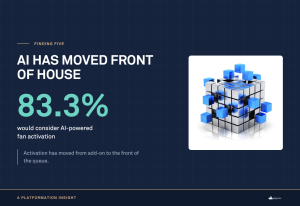
83.3% of buyers would consider AI-powered fan activation. Read past the technology and look at where that number sits. Fan activation has traditionally been a secondary consideration, the part of a deal discussed after the exposure and the hospitality are settled.
For more than four in five buyers to say they’d consider an AI-powered version of it tells you the market’s appetite for innovation has moved to the front of the queue. This isn’t buyers chasing a trend. It’s a signal that the things once treated as add-ons, activation, engagement, the experience built around the rights, are now where attention and money are heading. The brands asking what more a partnership can do, rather than just how visible it makes them, are the ones setting the pace.
The Full Picture
Take the five findings together and the direction is unambiguous. Investment is returning at scale, and a large share of it is being committed hard. The allocation of that investment is shifting, toward women’s sport and toward innovation. And underneath all of it, the expectation of rigorous measurement has become universal.
It describes a market that is more confident and more demanding at once: more money, moving faster, held to a higher standard of proof. The organisations best placed for what comes next are the ones that understand what their partnerships are actually worth, before they commit and before they renew. That’s where Platformation starts.
The SDMS 2026 findings are published in full at platformation.global/work/sdms/. If you’d like to talk through what they mean for your partnerships, we’d be glad to help.
Contact us: info@platformation.global
Platformation Enterprise Services Limited is a specialist sponsorship valuation agency, ISO 9001:2015 certified (Certificate No. GB2006233). The only sponsorship valuation agency, to our knowledge, whose methodology has been tested in a court of law.
platformation.global
You may also like...
The other World Cup: what a week at the Gothia Cup taught us about the real value of youth football
This summer, while much of the world was watching the FIFA World Cup unfold across the United States, Mexico and Canada, my family and I…
What the 2026 World Cup is quietly telling us about the commercial future of sport
Amongst all the noise surrounding this year’s World Cup, with its naming rights controversies, hydration break furore and geopolitical fault lines, two rather quieter stories…
Is Strade Bianche Now Cycling’s Sixth Monument?
Global interest in cycling is estimated at 651.7 million with Europe remaining the cultural heartland of cycling. 113.8 million Europeans show an interest in cycling;…
How to define value in modern sponsorship
Boards want evidence. Stakeholders see value differently. Our framework for defining sponsorship value around purpose, performance and efficiency brings clarity before the contract is signed.
Platformation did a great job for MarkSetBot on this project. It really helped launch both our marketing and fundraising efforts. We highly recommend them!
Matthew Morin
A valuable partner offering constructive input and innovation from across the world of football and beyond.
Petr Zascherinsky
Platformation have provided great insight and recommendations across our broad, diverse portfolio of events and content.
Walter Böhm
Andrew’s experience and understanding of the field offered great confidence and the rigour they applied to such a complex challenge was best in class.
Fiona Fletcher-Smith
Andrew and his international network of suppliers delivered a comprehensive set of valuable insights.
Simon Thomas
Resourceful and skilled, with a fantastic network and incredible experience. A valued and trusted business partner.
David Sim
Our Services
We support organisations at different stages of the sponsorship lifecycle, from understanding value to applying insight in practice. Each service addresses a specific question, while together they provide a clear, connected view of sponsorship performance.