
Insight
The Middle East Exchange: Capital Out, Sporting Value In
Middle East sports sponsorship is now a two-way exchange: capital flows out of the Gulf into world sport, and sporting value flows back. Three markets sit at the centre of it.
For a decade the story ran one way and was simple to tell. Capital left the Gulf and went into European sport: clubs, competitions, sponsorships, marquee events. What came back was sporting value, the properties, the IP and the credibility that money alone can’t manufacture. That exchange is still running, but it’s no longer one-directional. The region has stopped simply buying its way into sport and started building a market of its own. Three countries sit at the centre of that shift.
The Map of Middle East Sports Sponsorship
First, the map, briefly. The Middle East, or MENA once you fold in North Africa, is close to twenty markets depending on where you draw the line, from Morocco to Oman. Nobody serious treats it as a single audience, so this isn’t a piece about the region being diverse. It’s about where the commercial weight actually sits, and why so much of it concentrates in so few places.
By sheer scale, Egypt leads. 110 million people, the largest Arab population, and one of the most football-obsessed cultures anywhere, with around 85% following the game. But following isn’t spending, and Egypt’s commercial sponsorship market is still nascent. Which leaves the three markets where the money, the audiences and the ambition actually meet: Saudi Arabia, the UAE and Qatar. Three sovereign wealth funds, three structurally different audiences, three different commercial propositions. That’s the focus from here.
Where Middle East Sports Sponsorship Audiences Align
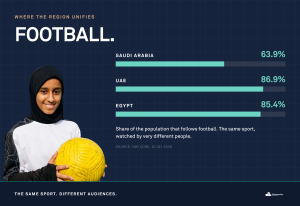
Football is the one thing that unifies the region. It’s followed by 63.9% in Saudi Arabia, 86.9% in the UAE and 85.4% in Egypt (GWI Core, Q1/Q2 2026). On a chart, those three numbers look like the same opportunity in three places. They aren’t.
The audience behind the number is built differently in each market, and that difference decides what a sponsorship can actually deliver. Saudi Arabia’s football audience is predominantly national. The UAE’s is substantially expatriate. The same sport, watched by very different people, for different reasons, reachable through different channels and moved by different messages, even when the logo sits on the same shirt.
The same sport, watched by very different people, is not the same product.
Where They Diverge
The divergence is sharpest in cricket and Formula 1. Cricket is followed by 41.9% in the UAE and 2.1% in Saudi Arabia (GWI Core, Q1/Q2 2026). That isn’t a difference in taste. It’s a difference in population. The UAE’s large South Asian community makes cricket one of its biggest broadcast sports. Saudi Arabia’s nationally dominant population makes it almost invisible. Same region, opposite propositions.
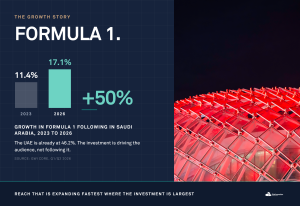
Formula 1 tells the other half of the story. Following in Saudi Arabia reached 17.1% in 2026, up from 11.4% in 2023, a rise of roughly 50% in three years. The UAE is already at 46.2% (GWI Core, Q1/Q2 2026). The Jeddah Grand Prix and Abu Dhabi’s season finale are pulling the numbers up in both markets. The Gulf is becoming F1 country, and the telling part is the direction of travel: the investment is driving the audience, not following it. That’s the reverse of how sponsorship usually works.
The Most Commercial Audience Isn’t Watching Sport
The most commercially significant figure in the Gulf isn’t a sports-following number at all. It’s personal interest in entrepreneurship. In Saudi Arabia, 70.3% of internet users name entrepreneurship as a personal interest, up from 53.9% in 2023 (GWI Core, Q1/Q2 2026). No other major market comes close.
That’s Vision 2030 landing in public consciousness: a generation told its future is in business rather than oil, and visibly absorbing the message. For a brand weighing a Gulf sponsorship, it reframes the activation question. This audience isn’t only watching sport. It’s commercially ambitious, digitally engaged, and becoming more so every year. What a partnership does for that audience, beyond putting a brand in front of it, is where the value now sits. Treating the Gulf as a pure reach play misses the part of the audience most worth reaching.
The LIV Golf Lesson
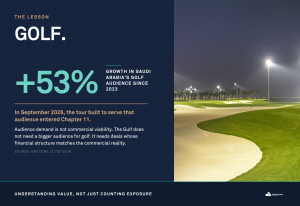
Saudi Arabia’s golf audience grew 53% between 2023 and 2026 (GWI Core, Q1/Q2 2026). The sport is genuinely taking root. In September 2026, LIV Golf entered Chapter 11 bankruptcy after the Public Investment Fund withdrew its backing. Both things are true at once, and they aren’t in tension. They’re the same lesson from two angles.
Audience demand is not commercial viability.
A growing fanbase doesn’t validate the financial structure of the deal built to serve it. LIV was built on sovereign ambition and a great deal of capital. It wasn’t built on a rigorous assessment of what the commercial structure could sustain once the ambition cooled. The Gulf doesn’t need a bigger audience for golf. It needs deals whose financial structure matches the commercial reality. That’s the problem that actually breaks partnerships.
A Market That’s Getting Harder to Fool
None of this is a market in retreat. It’s a market growing up. The question Gulf entities ask about sport has changed, and the change tells you exactly where it’s heading.
Five years ago the question was: how do we get in? Three years ago: how do we scale? Now: how do we prove it’s working?
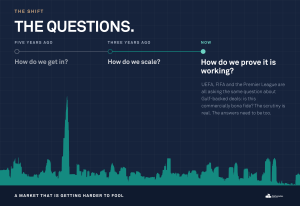
The scrutiny runs both ways. UEFA, FIFA and the Premier League are all looking harder at Gulf-backed deals, asking whether they’re commercially bona fide or state subsidy dressed as sponsorship. Rights holders on the other side face the mirror image: what is the IP actually worth to a buyer with effectively unlimited capital, and how do you price it without leaving value on the table? Both questions resolve to the same starting point, an independent assessment of what the partnership is genuinely worth. Without it, one side overpays and the other under-prices, and neither can prove which.
What Middle East Sports Sponsorship Means Commercially
Platformation has been active in the Middle East for years, with our own presence in the region. In that time we’ve been asked the same questions again and again, from both sides of the exchange: what does this partnership actually deliver, what is it worth, and does the price reflect that? The regional specifics change the inputs, national against expatriate audiences, a sport bought rather than inherited, an entrepreneurial public that reframes activation, but the discipline doesn’t.
The exchange only works when both sides can price it. Capital flowing out needs to know what it’s buying. Sporting value flowing back needs to know what it’s worth. Get that wrong and one side overpays while the other leaves value on the table, and in a market this size the gap is rarely small.
That’s the work we do. We tell rights holders what their IP is genuinely worth before they sell it, and brands what a partnership will actually return before they commit to it: a figure built from verified inputs, independently calibrated, and, as far as we know, the only sponsorship valuation methodology tested in court and held up. In a market where the capital is patient but no longer unquestioning, that’s the difference between a number you hope is right and one you can defend. Three markets, three propositions, one method for telling what each is actually worth.
If you’re evaluating Middle East sports sponsorship, or advising a client who is, we’d be glad to talk through what the data shows.
Contact us: info@platformation.global
Platformation Enterprise Services Limited is a specialist sponsorship valuation agency, ISO 9001:2015 certified (Certificate No. GB2006233). The only sponsorship valuation agency, to our knowledge, whose methodology has been tested in a court of law.
platformation.global
You may also like...

What Are You Actually Buying When You Commission a Sponsorship Valuation?
Sponsorship valuation is our flagship service. We’ve done it for years, at the highest levels of the industry, for some of the most consequential partnerships…
The other World Cup: what a week at the Gothia Cup taught us about the real value of youth football
This summer, while much of the world was watching the FIFA World Cup unfold across the United States, Mexico and Canada, my family and I…
What the 2026 World Cup is quietly telling us about the commercial future of sport
Amongst all the noise surrounding this year’s World Cup, with its naming rights controversies, hydration break furore and geopolitical fault lines, two rather quieter stories…
Is Strade Bianche Now Cycling’s Sixth Monument?
This article makes the case for a Strade Bianche sixth Monument, using the data on global interest in cycling. Global interest in cycling is estimated…
Platformation did a great job for MarkSetBot on this project. It really helped launch both our marketing and fundraising efforts. We highly recommend them!
Matthew Morin
A valuable partner offering constructive input and innovation from across the world of football and beyond.
Petr Zascherinsky
Platformation have provided great insight and recommendations across our broad, diverse portfolio of events and content.
Walter Böhm
Andrew’s experience and understanding of the field offered great confidence and the rigour they applied to such a complex challenge was best in class.
Fiona Fletcher-Smith
Andrew and his international network of suppliers delivered a comprehensive set of valuable insights.
Simon Thomas
Resourceful and skilled, with a fantastic network and incredible experience. A valued and trusted business partner.
David Sim
Our Services
We support organisations at different stages of the sponsorship lifecycle, from understanding value to applying insight in practice. Each service addresses a specific question, while together they provide a clear, connected view of sponsorship performance.