
Insight
Charity Sponsorship: Growing Appetite, Missing Structure
More brands than ever say they back charities, but charity sponsorship money hasn’t followed. We went to the data and the people to find out why.
Charity Sponsorship Five Years On
In July 2021, on the back of our first Sponsorship Decision Maker Survey and two interviews with people on opposite sides of the sponsorship table, we published an early analysis of charity sponsorship. It read as a guide for charities. This piece asks the question from the other side. More brands than ever say they sponsor charities and social causes, but has the money behind charity sponsorship become anything a charity would recognise as a partnership?
The data suggests mostly not. The way out starts with dropping a comfortable assumption: charity sponsorship is commerce, not philanthropy. It works when both sides treat it as a partnership with something real to offer each other.
To test that, we went back to Lisa Basford, one of the two people we interviewed in 2021. She is the founder and director of Good Endeavours, a responsible business consultancy, and spent 11 years at InterContinental Hotels Group, latterly as Global Director of Corporate Responsibility, where she ran the company’s corporate charity and impact reporting. She has also led partnerships and social impact at O2 (Telefónica UK), and is a Fellow of the Institute of Corporate Responsibility and Sustainability. Her full credentials are in the sources.
The Appetite Is Real
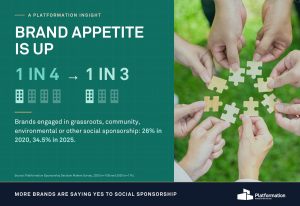
In 2020, when we first surveyed sponsorship decision-makers on this, roughly one in four brands (26%) said they were actively engaged in grassroots, community, environmental or other social sponsorship. In our 2025 wave, that figure was 34.5%, more than one in three.
Brands no longer treat this as a fringe category. It sits alongside sport, arts and culture and trade events as a mainstream line in the sponsorship portfolio, and it has grown faster than most of its neighbours. If the question is whether brands want it, the answer is yes.
The Money Hasn’t Followed
Set that appetite against what’s actually happening in the UK charity sector, and the picture gets more complicated.
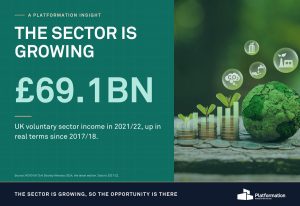
Total income into UK voluntary organisations has grown in real terms, reaching £69.1bn in 2021/22, the latest year NCVO has published. But the private sector, the corporate and business giving line, hasn’t kept pace. Its share of total sector income was lower at each of these points than at the one before: 6% in 2000/01, 5% in 2017/2018 and down to 3% in 2021/22.
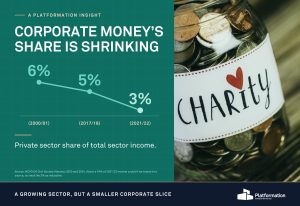
More brands say they’re engaged. The sector’s own numbers say corporate money is a shrinking slice of a growing pie. The likeliest explanation is that most of what brands count as charity sponsorship isn’t landing as durable, structured investment a charity can plan around. It’s one-off, occasional, or a logo on a page, not a platform.
A word of caution. NCVO’s series puts the private sector share at roughly 4% to 6% for most years from 2005/06 to 2018/19, so this is a long drift with a sharp drop at the end. About a fifth of 2021/22 income also couldn’t be traced to a source, so read the 3% as indicative.
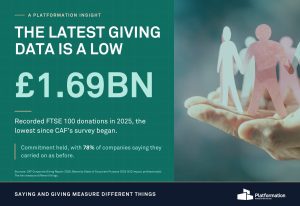
More recent evidence points the same way. The CAF Corporate Giving Report 2026 puts recorded FTSE 100 donations at £1.69bn in 2025, the lowest since its survey began. Benevity’s State of Corporate Purpose 2026 finds that commitment has held, with 78% of companies carrying on as before, but 76% now talk about it more quietly.
That’s not a fundraising problem. It’s a sponsorship strategy problem, and it’s one we know how to fix.
What a Charity Actually Has to Offer
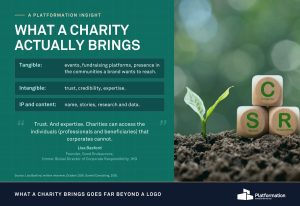
Ask Lisa what a charity brings to a brand and her answer is short: “Trust. And expertise. Charities can access the individuals (professionals and beneficiaries) that corporates cannot.”
That’s the point most pitches miss. A charity isn’t asking for a favour. It holds assets a brand can’t build or buy, and they fall into three groups:
- Tangible. Events and participation (the runs, the challenges, the volunteering days), fundraising platforms, and a physical and digital presence in the communities a brand wants to reach.
- Intangible. Trust, credibility and community access, plus the expertise and the people Lisa describes.
- IP and content. The charity’s name, marks and stories, its research and data, and the right to use them. Darnell Consulting’s 2026 research, drawing on 100 companies with active partnerships and ten decision-maker interviews, found that companies want content in multiple formats that works on their own social and internal channels.
Scannappeal, the charity that supports the NHS in Buckinghamshire, shows what this looks like in practice. Karen Shardlow, its Chief Executive, and Nigel Naylor-Smith, its Head of Corporate Partnerships, describe a portfolio built around different audiences in a business: wellbeing events for employees, networking breakfasts with business speakers for leaders, and patient stories and volunteering at NHS sites for the whole company. Karen’s test is the one this piece keeps returning to: “a successful partnership should offer more than the satisfaction of supporting a good cause.”
The most distinctive asset is the most physical. Nigel points to “visibility of actual medical equipment” as a form of validation. Scannappeal’s recent appeal for a new mobile breast screening unit for South Bucks had a target of £410,000, with 10,000 women being invited to screening on it each year. The charity places great importance on recognising the generosity of its supporters, from plaques on hospital walls to recognition featured directly on funded equipment. For businesses supporting the mobile breast screening unit, this can mean public recognition for up to 10 years, the lifetime of the unit.
Why It’s About Employees, Not Eyeballs
For a growing number of brands, the audience that matters most sits inside the building. Lisa’s view is blunt: “Employee engagement is a huge driver, and it builds a stronger workforce.” She points to a telling sign: “There is a reason job advertisements now promote volunteer days as part of a package of employee benefits or promote an organisation’s sustainability efforts.” In her experience the younger generation prefers to work for an organisation with strong ESG credentials. KPMG’s survey of around 6,000 UK adults, published in January 2023 and reported by edie and ISEP, found that one in five had turned down a job offer because the company’s ESG commitments didn’t match their values, rising to one in three among 18 to 24 year olds.
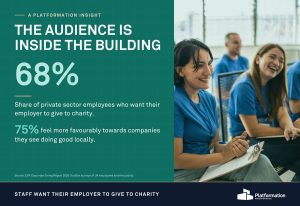
The figures fit. The CAF Corporate Giving Report 2026 finds that 68% of private sector employees want their employer to give to charity, and 75% feel more favourably towards companies they can see doing good locally.
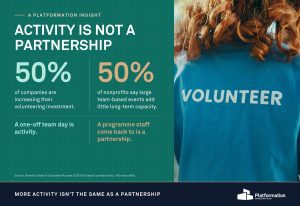
There’s a catch. Benevity’s 2026 report finds that 50% of companies are increasing their volunteering investment, but 50% of nonprofits say large team-based events add little long-term capacity. The value sits with the employees, but only if the structure is there to keep it.
Many businesses are keen to offer their time through volunteering, something the charity warmly welcomes but alongside this “we encourage businesses to consider how they might also support our fundraising appeals. By agreeing a fundraising commitment alongside volunteering opportunities, we believe we can create partnerships that are meaningful for both sides”, Scannappeal says.
Credible or Greenwashing?
This is where the morality-versus-commerce tension bites. A charity can’t look too commercial, or it loses the trust that makes it valuable. A brand can’t look like it’s buying virtue, or the partnership reads as greenwashing. Meanwhile charities compete with each other for the same budgets. Darnell’s review of more than 80 “charity of the year” schemes found that about 90% shortlist their applicants, typically around six.
For a local charity, the competition is wider than other local causes. Scannappeal describes being weighed against national names such as Cancer Research, Macmillan and the NSPCC, which businesses recognise at once, and against global frameworks such as the UN Sustainable Development Goals that some larger companies adopt. Its answer is to show what is changing locally, for the employees who live and work near the head office.
Scannappeal’s answer starts with trust. Nigel notes that the charity makes commitments directly to its beneficiary, Buckinghamshire Healthcare NHS Trust patients, their families and staff. For the mobile unit, that means committing to raise £410,000 so the technology can be bought. Partnerships need open dialogue, a joint roadmap and reciprocity. On greenwashing, Nigel is direct: “Greenwashing is only avoided when both sides are held to account for their leadership commitment and verifiable outcomes being achieved.” Karen puts the starting point simply: “Charities need to be commercially aware and for us the starting point is always trust.”
What Nigel and Karen describe isn’t only their experience. After the conversation, we went back to the Charity Commission register to check, and it pointed the same way. Of the 149,643 registered charities in England and Wales reporting an income, 82,363 work in a single local authority area. That’s 55% of all charities, and between them they hold about 22% of the sector’s income. The typical one has just under £20,000 a year to work with.
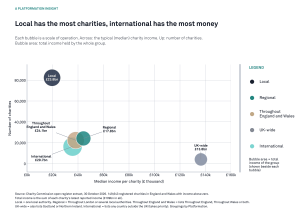
At the other end, the picture is very different. Just 575 charities, 0.4% of the total, hold half of all the money. Those are the names a business recognises at once, which is why a local charity weighing itself against Cancer Research, Macmillan and the NSPCC is up against the shape of the whole sector, not only a few well-known competitors. And the local base is thinning. Since 2012, England and Wales has lost a net 4,149 local charities, while charities working throughout England and Wales have grown by 8,042.
There’s a more encouraging reading. A £25,000 partnership is more than a year’s income for the typical local charity, and it’s material, between a tenth of a year’s income and a whole year’s, for about 51,000 charities, more than half of them local. The money and the need can meet. What’s missing is the structure that lets them: a clear offer, an agreed way to show results, and a way to tell a partnership from a gesture.
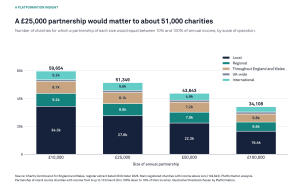
So there’s no shortage of charities worth backing. The harder question is how a brand tells a partnership that works from one that only looks good. Lisa Basford has spent her career on that question.
Lisa’s test for telling credible from cosmetics is simple. The partnership “has to make sense for both”: for the charity and its beneficiaries, and for the corporate and its customers and employees. Then comes the question she’d put to any brand: “Does this partnership help us to achieve our Theory of Change? If not, then why are you doing it?”
The pressure runs both ways. Darnell found that purpose-led marketing without demonstrated commitment is losing credibility. Evidence is part of the answer, but Lisa warns that funders often ask too much: “It is often the funder who is unrealistic about what a charity can and cannot report on.” Benevity’s nonprofit survey supports her: 42% report more custom metric demands, and 48% absorb the extra work through unpaid overtime. A credible partnership asks for evidence it can use, not evidence for its own sake.
Scannappeal sees the same shift. Nigel says businesses want to see tangible impact, but “Validation is not necessarily through provision of hard data, but the storytelling must be authentic and be matched with business CSR objectives.” A clinician’s or patient’s statement can do that, or the equipment itself. Karen adds: “It’s no longer simply about writing a cheque and putting a logo alongside a charity’s name.” Both point to the same practical step: agree what evidence is needed in the first partnership conversations.
Six Questions Before You Sign a Charity Sponsorship
If credibility is the test, what does a partnership that passes it look like? In 2021 we set out six pillars for a successful charity sponsorship, drawn from interviews with Lisa and Richard Morris of TheGivingMachine: do the homework, build a strategy not a gesture, develop the partnership, form alliances, build a credible platform, and communicate the investment. They still hold up for any charity sponsorship today.
Five years on, Lisa says the why hasn’t changed, but the how has. “I still prefer partnership,” she told us, “to describe an alignment of values, mission and minds. Not just a commercial transaction. Partnership is about working together to solve societal problems, not just about branding.”
The shift she’s watching is in ambition. What used to be shorter-term programme activity is moving, in some organisations, towards a longer view and an attempt to drive system change. “Businesses run on short cycles: they are always looking at last month’s sales, revenue forecast for next quarter. It requires a big shift to consider long term system change.” Her conclusion is that both have a place: “We need both. Corporates need to decide what they want to do and how they will measure.”
She points to three models. The Zurich Foundation, which describes its own focus as driving systems change, is her example of the longer view. Standard Life’s Centre for the Future of Retirement, a think tank Phoenix Group set up in 2021 and rebranded in 2025, puts corporate research behind a policy question. Virgin Media O2’s work with the National Databank and Good Things Foundation, which the company says has connected more than 550,000 people to free mobile data, is programmatic support on digital poverty. A company should choose between them deliberately, then decide how it will measure the result.
Read against this year’s evidence, the pillars work as six questions a brand can ask before it signs or renews.
- Why are we doing this? Start with Lisa’s test: does the partnership help us achieve our Theory of Change? If you can’t say how, it’s a gesture, however generous the cheque.
- What are we actually buying? Ask for tangible, intangible and IP assets, and expect a charity that knows its worth to price all three. See what a sponsorship valuation includes. Most conversations stop at the logo.
- Is there a programme our people come back to? A one-off team day is activity. A series of activities that staff return to is a partnership.
- Have we chosen between programme and system change on purpose? Lisa’s view is that both have a place. The risk is funding one as if it were the other, and judging it by the wrong yardstick.
- What will we measure, and who collects it? Agree it before you sign, and ask for evidence you’ll actually use.
- Can we explain where the money goes? Say what you fund, why and what it achieved, or the silence gets read as opacity.
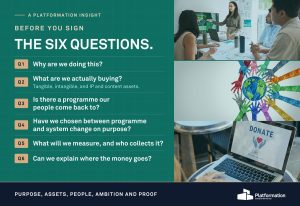
Count the questions you can answer yes to, with evidence. As a rough rule of thumb, ours and not research: five or six is a platform, three or four is a start, and two or fewer is still a gesture.
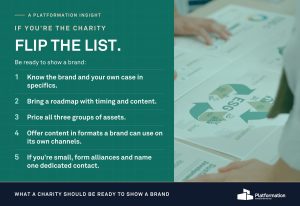
The same list works from the other side of the table. If you’re the charity, know the brand and your own case in specifics, bring a roadmap with timing and content, price all three groups of assets, and offer content in formats a brand can use on its own channels. If you’re small, form alliances so you can offer scale, and name one dedicated contact.
Where We Stand on Charity Sponsorship
Put the voices and the numbers side by side and four things hold.
The appetite is real, and it’s about people as much as profile. More than one in three brands now sponsor grassroots, community, environmental or social causes, and employees want it.
The money hasn’t followed, and what there is reaches the few. Just 575 charities hold half of all charity income, while the 55% of charities that are local hold about 22%.
What’s missing is structure, not goodwill. About 51,000 charities could treat a £25,000 partnership as material income. What connects them to brands is a priced offer, a roadmap with timing, evidence agreed at the start and one named contact. In our Sponsorship Decision Maker Survey 2026 (n=204), 70.6% of buyers rate measurability four or five out of five, their highest-rated priority. In our reading, charity partnerships are rarely set up to show results in that way.
Credibility is a test for both sides. A charity has to look commercially aware without losing trust. A brand has to add real, tangible value, not only volunteers whose main benefit is to the staff who turn up. As Nigel puts it, greenwashing is avoided “when both sides are held to account”. In ESG terms, which is our reading, the appetite is the social part and the governance of a partnership is what keeps it credible.
We should say where we come from. Platformation is a commercial sponsorship consultancy, and that’s the lens we bring. But we’re not outsiders to this. We are active sponsors of SportsAid’s lunches, a three-year commitment, and both of us have been closely involved in many fundraisers over the years. Platformation has sponsored CAWC International, a philanthropic social society, where I have been a member and the sponsorship coordinator for many years. Its annual fundraising event regularly raises over £20,000 in a day for local charities, and its chosen charity for 2026 is Scannappeal. We know what it takes to ask for money, and what a good partnership feels like from the charity’s side.
That’s why we’d put the case for charities more firmly than they sometimes put it themselves. They aren’t asking for a favour. They offer tangible assets such as events, platforms and a physical presence in a community, intangible ones such as trust, credibility and access to people a brand can’t reach alone, and intellectual property, including names, stories, research and data. Those have real commercial value, and we’d say so plainly to any brand that wants to engage with a charitable cause.
The same logic runs the other way. Volunteering and the wider ESG agenda are real and valuable, and employees often gain a lot from them. But as Scannappeal says, a partnership should offer more than the satisfaction of supporting a good cause. Sending volunteers so that staff feel good about the company isn’t enough. A brand that wants the credit has to put something tangible in: money, skills, reach, a commitment that lasts beyond a campaign. That’s also what makes the partnership worth having for the brand.
Charity sponsorship doesn’t have an appetite problem. It has a structure problem, and both sides can build structure into their next charity sponsorship this quarter.
If you’re a brand, pick one charity partnership you already have and run it through the six questions. Then add one tangible commitment beyond volunteers, whether that’s money, skills, reach or time, and agree with the charity, at the start, what evidence you’ll both use.
If you’re a charity, price what you offer across all three groups, tangible, intangible and IP, and put a roadmap with timing behind it. If you’re small, look for an ally to offer scale, and name one person who answers the phone.
Do that, and the 82,000 local charities and the brands that say they want to help stop being two lists and start being partners. If you’d like a second pair of eyes on a partnership, ours or yours, we’d be glad to talk, whether that starts with our Market Research service, a specialist look at the partnership or a simple conversation: info@platformation.global.
Platformation Enterprise Services Limited is a specialist sponsorship valuation agency, ISO 9001:2015 certified (Certificate No. GB2006233). The only sponsorship valuation agency, to our knowledge, whose methodology has been tested in a court of law. platformation.global
Sources and References for Charity Sponsorship
Sources cited in this article, listed alphabetically by publisher. Where a figure comes from a web page and not a full report, the entry says so.
Basford, L. (2021) Interview, in Platformation, Charity Sponsorship under the lens.
Basford, L. (2026) Written responses to Platformation’s interview questions, October 2026. Quoted with permission. Lisa Basford is Founder and Director of Good Endeavours; see also her LinkedIn profile.
Benevity (2026) State of Corporate Purpose 2026. Web report only: no PDF was available at the time of writing. benevity.com/state-of-corporate-purpose/2026
Charities Aid Foundation (2026) Corporate Giving Report 2026: Leading a culture of giving. London: CAF. cafonline.org/corporate-giving-report
Charity Commission for England and Wales (2026) Register of charities: extract of main registered charities, 30 October 2026, analysed by Platformation. Main registered charities with income above zero; scale from the area-of-operation field; income sources from Part B returns. The Charity Commission – GOV.UK
Darnell Consulting (2026) Market research findings: corporate partnerships. Presented at the Chartered Institute of Fundraising Corporate Partnerships Insights webinar, 20 May 2026. Webinar slides (PDF)
KPMG UK (2023) Press release, “Climate quitting: younger workers voting with their feet on employer’s ESG commitments”, January 2023. Reported in: edie, “Climate quitters: one-fifth of UK workers have turned down jobs based on poor ESG commitments”, edie.net; ISEP, “One in three young workers turn down jobs due to poor ESG records”, isepglobal.org; and Water Magazine, 11 April 2023, watermagazine.co.uk.
Naylor-Smith, N. and Shardlow, K. (2026) Written responses to Platformation’s interview questions, October 2026, and conversation of 29 October 2026. Nigel Naylor-Smith is Head of Corporate Partnerships and Karen Shardlow is Chief Executive of Scannappeal. Quoted with permission.
NCVO (2020) UK Civil Society Almanac 2020. London: NCVO and Charity Commission. Figures as cited in Platformation (2021).
NCVO (2024) UK Civil Society Almanac 2024, including data tables B2 and C6. London: NCVO, Third Sector Research Centre and Charity Commission. Data to 2021/22; the next edition has been delayed. ncvo.org.uk/news-and-insights/news-index/uk-civil-society-almanac-2024
Platformation (2021) Charity Sponsorship under the lens. Original report and interviews with Lisa Basford (Good Endeavours) and Richard Morris (TheGivingMachine), July 2021.
Platformation (2020, 2025, 2026) Sponsorship Decision Makers Survey. 2020, 2025 and 2026 waves: sponsorship of grassroots, community, environmental or other social programmes (2020, 2025) and buyers’ top priorities, including measurability (2026). platformation.global
Scannappeal (2026) Mobile Breast Screening Appeal and Our Impact, scannappeal.org.uk/appeals/mobile-breast-screening-appeal and scannappeal.org.uk/our-impact. Figures are the charity’s own. Checked on 30 October 2026.
Standard Life Centre for the Future of Retirement (2025) Who we are, and Workplace Journal (2025) ‘Phoenix Insights rebrands as Standard Life Centre for the Future of Retirement’, 16 June 2025. Centre page; Workplace Journal
Virgin Media O2 (2026) ‘Over half a million people connected with free O2 mobile data through the National Databank as Virgin Media O2 renews partnership with Good Things Foundation’, press release, 17 August 2026. Figures are the company’s own. news.virginmediao2.co.uk
Zurich Foundation (2025) Impact Report 2025. Figures and description of approach are the Foundation’s own. Impact Report 2025 (PDF)
Also consulted
Benevity (2025) ‘From attendance to engagement: employee volunteerism fuels a stronger workforce’, 22 August 2025. Blog post
BHP Chartered Accountants (2025) ‘Charity reporting in 2026: understanding the final SORP and threshold changes’, 2 December 2025. Blog post
C&E Advisory (2026) The 2026 Corporate-Non-profit Partnerships Barometer: Beyond Resilience. candeadvisory.com/barometer
Charity Commission for England and Wales (2026) Public Trust in Charities 2026, 8 July 2026. gov.uk
Charity Commission and Frontier Economics (2019) The Value of the Charity Sector: an overview. September 2019.
House of Commons Library (2017) Charities and the voluntary sector: statistics, briefing paper SN05428, 16 August 2017.
Tree of Hope (2026) ‘Corporate Social Responsibility in 2026: what businesses are looking for in a charity partner’, 1 July 2026. Blog post
Zurich UK (2023) ‘UK charities awarded £3 million in donations from Zurich Community Trust’, press release, 9 February 2023. zurich.co.uk
You may also like...
The Middle East Exchange: Capital Out, Sporting Value In
Middle East sports sponsorship is now a two-way exchange: capital flows out of the Gulf into world sport, and sporting value flows back. Three markets…
Golf Sponsorship: What the Numbers Actually Show
Golf reaches a bigger, wealthier and more commercially useful audience than most brands assume. The harder question isn’t whether to be in the sport. It’s…

SDMS 2026: The Full Picture
About the sponsorship decision maker survey Five findings from the Sponsorship Decision Maker Survey 2026. Seen together, they describe a market that has decided where…

What Are You Actually Buying When You Commission a Sponsorship Valuation?
Sponsorship valuation is our flagship service. We’ve done it for years, at the highest levels of the industry, for some of the most consequential partnerships…
Platformation did a great job for MarkSetBot on this project. It really helped launch both our marketing and fundraising efforts. We highly recommend them!
Matthew Morin
Platformation have provided great insight and recommendations across our broad, diverse portfolio of events and content.
Walter Böhm
Andrew’s experience and understanding of the field offered great confidence and the rigour they applied to such a complex challenge was best in class.
Fiona Fletcher-Smith
Andrew and his international network of suppliers delivered a comprehensive set of valuable insights.
Simon Thomas
Resourceful and skilled, with a fantastic network and incredible experience. A valued and trusted business partner.
David Sim
Our Services
We support organisations at different stages of the sponsorship lifecycle, from understanding value to applying insight in practice. Each service addresses a specific question, while together they provide a clear, connected view of sponsorship performance.


