
Insight
Will 2026 be a turning point for Super League’s TV rights?

In 1895, a dispute over professionalism split British rugby into two codes: rugby league and rugby union. More than a century later, their leading domestic competitions, Super League and Premiership Rugby, remain closely matched on the pitch and in the stands. Both average crowds of more than 10,000 per game.
Off the field, the picture is very different.
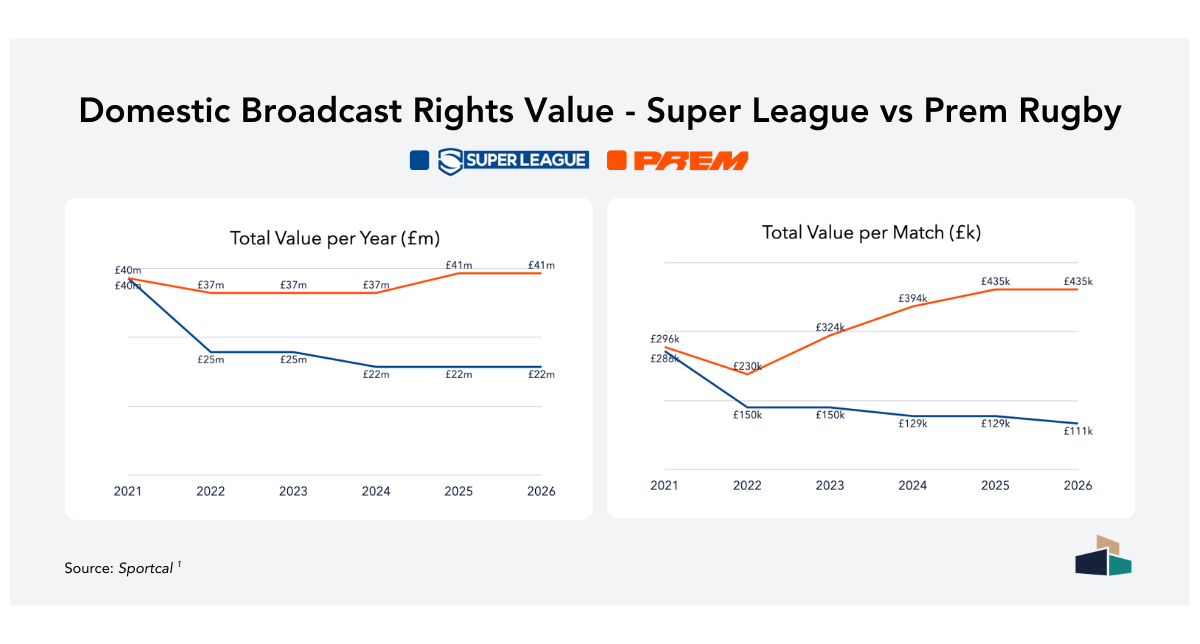
Despite offering more than twice as many live matches, Super League earns significantly less broadcast revenue per game than Premiership Rugby. That gap is not driven by audience demand, but by how Super League’s media rights have historically been structured and negotiated. With broadcast talks reopening in 2026, that imbalance is now under scrutiny.
The valuation gap
Super League currently receives around £111,000 per match in domestic broadcast revenue. Premiership Rugby receives approximately £435,000 per match¹.
This is despite Premiership Rugby offering just 93 matches per season, compared with 194 from Super League. On a per-game basis, Super League is valued at 3.9 times less.
That differential is difficult to justify on broadcast performance alone.
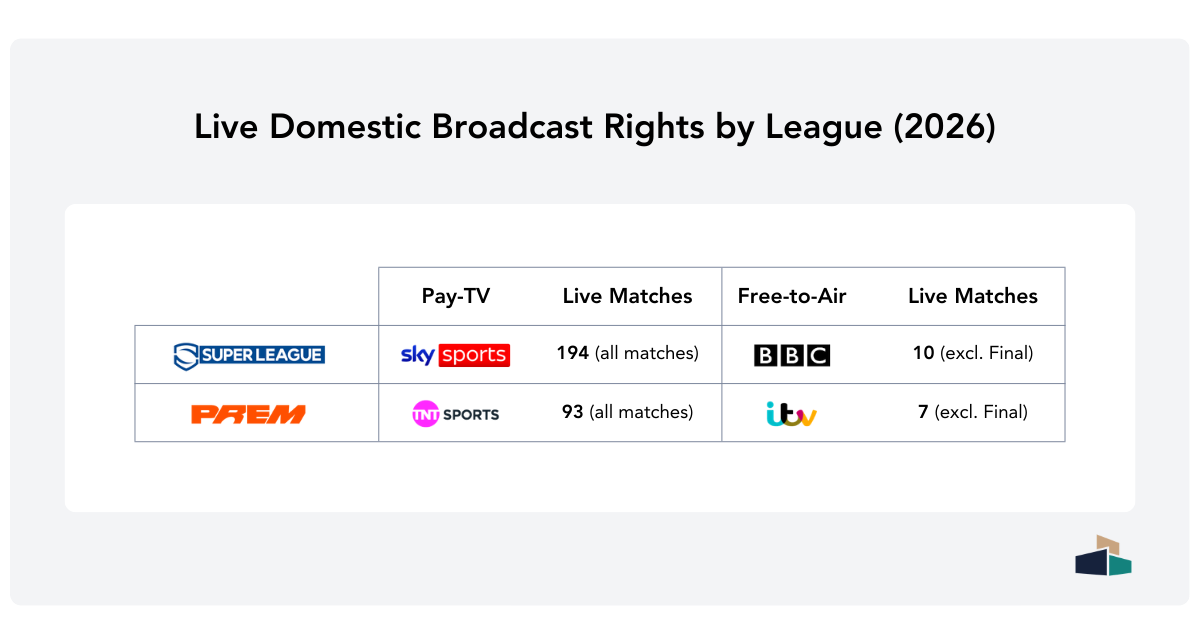
The 2025 Premiership Rugby Final averaged 973,000 viewers², boosted by simulcast coverage across TNT Sports and ITV1. By comparison, the 2025 Super League Grand Final, broadcast exclusively on pay TV, averaged 455,000 viewers³ on Sky Sports.
More importantly, Super League audiences are moving in the right direction. Across the 2025 season, broadcast viewing grew by 52 percent year on year⁴, while Premiership Rugby has faced well-documented pressure on viewing figures alongside financial contraction.
Structural change will amplify this contrast. From 2026, Super League will expand from 12 to 14 clubs, increasing its volume of live broadcast inventory. Premiership Rugby has moved in the opposite direction, contracting from 13 clubs to 10 in recent years.
Taken across a full season, most industry observers recognise that the true gap in broadcast engagement is far narrower than the near fourfold difference implied by current per-match valuations.
Why Super League’s rights are undervalued
The issue is not demand. It is market design.
A familiar negotiation pattern
Across recent rights cycles, Super League has followed a similar path. The league engages its incumbent broadcaster while testing interest from alternative platforms to create competitive tension.
In practice, the same challenge emerges. The full rights package is large, expensive and high risk for a new entrant to acquire in one step. As potential bidders fall away, leverage shifts. The market narrows to a single realistic buyer.
The outcome has been predictable. Deals that sustain the competition operationally, but deliver exceptional return on investment for the broadcaster left standing.
Step one: quantify the real value
Ahead of the 2026 negotiations, Super League needs an independent, commercial view of the value it delivers.
Leading sports properties now go to market with profit-based models, not just audience numbers. These models quantify how content contributes to broadcaster economics across four areas:
- advertising and subscription revenue
- customer acquisition and retention
- wider ecosystem and brand effects
- and associated production and distribution costs
This analysis allows rights holders to understand genuine leverage, stress-test valuation assumptions, and model trade-offs between pay-TV value, free-to-air reach and sponsorship growth.
Without this, negotiations rely on instinct and precedent. With it, they are grounded in evidence.
Step two: redesign the rights structure
Exclusive, all-in rights packages are increasingly misaligned with a fragmented broadcast market. While simple, they raise risk for new entrants and reduce competitive tension.
A more effective approach is fractionalisation.
By dividing rights into multiple packages, differentiated by volume, timing and fixture profile, Super League can lower barriers to entry and broaden the bidder pool. Platforms such as DAZN, TNT Sports, Channel 4, Channel 5 or Premier Sports can participate at levels aligned to their strategies and budgets.
For this to work, packages must be deliberately designed around broadcaster demand, expected audiences and fixture quality. Without that discipline, the market simply collapses back to a single buyer, and the underlying value remains unrealised.
Turning growth into value
Super League has built genuine momentum. Attendance is up. Audiences are growing. The competition is expanding.
The challenge now is converting that progress into sustainable commercial return. That requires preparation, market insight and smarter rights design.
The 2026 negotiation window represents a clear inflection point. With the right strategy, there is a credible route to materially improved outcomes. Without it, the disconnect between on-field progress and off-field returns is likely to persist.
In that sense, the most important decisions facing Super League will not be made on the pitch, but at the negotiating table.
In conclusion
Super League enters its next broadcast cycle with stronger fundamentals than its current valuation reflects. Turning that strength into value will depend on how clearly the league can evidence its contribution to broadcasters and how intelligently it takes its rights to market.
RL Commercial teams preparing for the 2026 cycle can access independent support in TV rights valuation, packaging and negotiation.
¹ Based on Sportcal analysis: “Rugby codes tackling the fall in media rights value,” Sportcal, available at https://www.sportcal.com/analyst-comment/rugby-codes-tackling-the-fall-in-media-rights-value/?cf-view
² Based on Premiership Rugby broadcast reporting: “Final 2025 officially the most-watched Premiership Rugby fixture ever,” Premiership Rugby, confirming an average audience of c.973,000 viewers for the 2025 Final across TNT Sports and free-to-air ITV1, available at https://www.premiershiprugby.com/content/final-2025-officially-the-most-watched-premiership-fixture-ever
³ Based on Super League broadcast reporting: “Super League Grand Final posts huge TV figures with major increase on 2024,” Love Rugby League, confirming an average audience of c.455,000 viewers for the 2025 Super League Grand Final on Sky Sports (pay-TV only), available at https://www.loverugbyleague.com/post/super-league-grand-final-posts-huge-tv-figures-with-major-increase-on-2024
⁴ Based on Super League audience growth reporting: “Betfred Super League sets historic attendance record as 2025 regular season concludes,” Super League, noting year-on-year broadcast audience growth of approximately 52% across Sky Sports and BBC platforms during the 2025 season, available at https://www.superleague.co.uk/article/5453/betfred-super-league-sets-historic-attendance-record-as-2025-regular-season-concludes
You may also like...
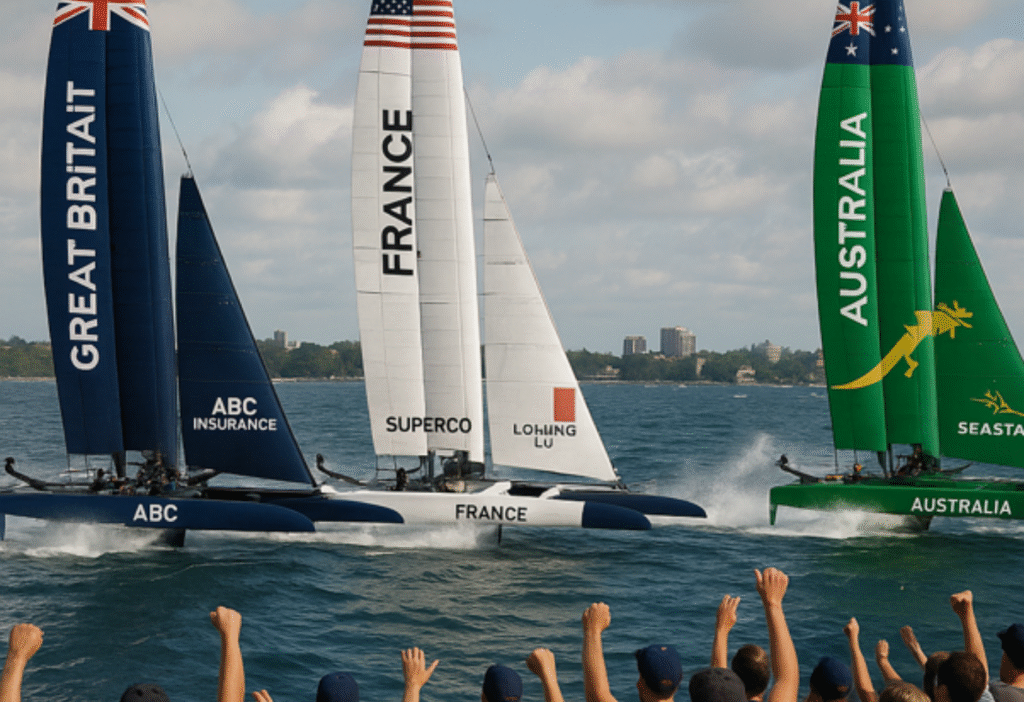
SailGP’s winning formula: The power of branding
An analysis of SailGP’s team model and why national identity, combined with sponsor branding, delivers value for fans and partners.

Revisiting the Elimination Mile
A look at why alternative formats are quietly re-emerging in athletics, and whether the Elimination Mile could offer a low-risk way to deepen fan engagement.

The forgotten maths that transformed sport
Can competition format drive audience growth? Using Speedway as a case study, this piece explores whether a forgotten mathematical framework still has relevance today.
Platformation did a great job for MarkSetBot on this project. It really helped launch both our marketing and fundraising efforts. We highly recommend them!
Matthew Morin
A valuable partner offering constructive input and innovation from across the world of football and beyond.
Petr Zascherinsky
Platformation have provided great insight and recommendations across our broad, diverse portfolio of events and content.
Walter Böhm
Andrew’s experience and understanding of the field offered great confidence and the rigour they applied to such a complex challenge was best in class.
Fiona Fletcher-Smith
Andrew and his international network of suppliers delivered a comprehensive set of valuable insights.
Simon Thomas
Resourceful and skilled, with a fantastic network and incredible experience. A valued and trusted business partner.
David Sim
Our Services
We support organisations at different stages of the sponsorship lifecycle, from understanding value to applying insight in practice. Each service addresses a specific question, while together they provide a clear, connected view of sponsorship performance.