
Insight
Brand equity under the spotlight
Ever wonder why the big brands, spend the big bucks on the Olympic Games when there isn’t a perimeter board or a shirt front to be covered in a logo? After all, it is not as though the brands who can afford these fees are struggling to achieve awareness. Coca-Cola or Visa to name but two are brands who have long since become eponymous for their whole sector. So why bother with the sponsorship at all?
Intellectual Property
The thing is, exposure and awareness are important factors for many/most commercial partnerships but nearly two-thirds of sponsorship decision makers* claim to clearly prioritise “Intellectual Property” (IP) of a sponsored property as an asset and see the ability to integrate it into their own marketing as crucial. A similar proportion see this as distinct asset in its own right and would be open to considering an independent valuation of the rights, when weighing up the sponsorship fee.
This begins to lay clear the draw of the Olympic partnerships. All the more so, in light of the fact that when asked to name brands from the world of sport and the corporate/commercial world, the Olympic Games was the very top choice, ahead of Apple, which was the only corporate brand to outscore the FIFA World Cup, UEFA Champions League and the Premier League, each of which scored stronger than the likes of Amazon, Disney or even the aforementioned, Coca-Cola!
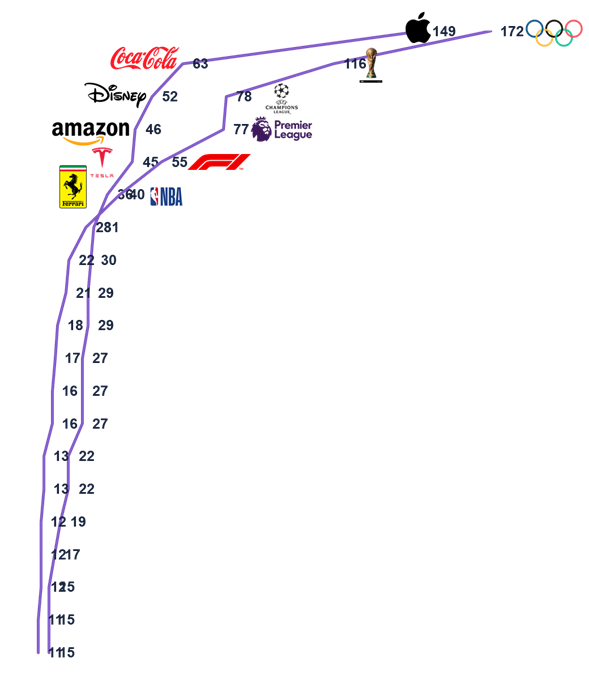
Sponsorship Decision Maker Survey 2022; Brand Equity Companies vs Brand Equity Sport
Brand Equity
So what does make a brand? In fact, brand research is a well established practice in the corporate world and although there are differing approaches, by and large they all agree on the following factors:
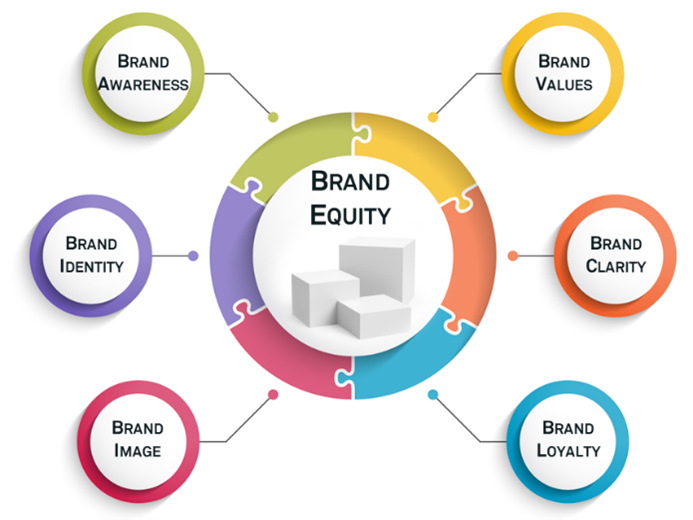
Brand Awareness – Not only recall of the name but familiarity with the logo, products and history.
Brand Identity – Who does the brand claim to be? What is the deliberate and active message (e.g. slogan) that they use to position themselves with the target group.
Brand Image – The impression of a brand that often results from a comparison between initial expectation and the reality of experiencing the brand or perhaps a direct benchmarking against a competitor. More complex and contextual than a simple positive/negative opinion, this can also involve more granular detail and be influenced by product reliability, after sales care, etc. or how a brand deals with the world around it (e.g. sustainability, equality and inclusion, etc.).
Brand Values – In contrast to the Brand Identity, this is the perceived attributes of the brand by the consumer. Is it “modern”, “trendy”, “high quality”, “advanced technology”, “premium service”, etc.
Brand Clarity – Quite simply, how clearly defined and matching are the Brand Identity, Image and Values, as defined above. Is there a consistency in how the brand is perceived or does it mean different things to different people.
Brand Loyalty – Repeat business is part of the loyalty factor but it goes beyond returning to buy and relates also to the ability to turn customers into advocates who will promote the brand and help create a positive environment around the brand.
In fact, these components of a brand’s equity translate rather neatly into the context of brands in sport. Moreover, by facilitating the granular comparison of a sports brand and potential commercial partner, we can begin to understand what influence the partnership can be expected to have. Of course, a direct match would be pointless, as it would leave no scope to shift the needle but equally, a lack of fit will also miss any of the credibility that underpins all successful sponsorships.
Assessment of sport properties
An assessment of brand can help the sports property to better understand their position, qualify and quantify their USPs in the competitive market place and also inform how to steer and deliberately curate the brand for future growth. For a corporate brand assessing the sports brand is a sensible measure to identify, a platform that can help them influence their own brand in the manner they are striving for.
This all happens in a very competitive and interconnected environment. While each (e.g.) football club or league can set themselves up distinctly in terms of their tangible assets (although many don’t!), your peers, competitors and others all play an influential role in the nature of your IP. The image of the English national team (men or perhaps very pertinently given yesterday’s success, now the women!) is in large part defined by direct comparison to their peers in France, Germany, Italy, Spain and right around the world; it is impacted by the tournaments they play in; it is influenced by and influencing the perception of English football; and to some extent even the Premier League and their member clubs where the squad feature on a week by week level. These can be negative or positive influences of course. But while these brands are somehow interconnected, they are also quite distinct on a granular level and these are the subtle differences and characteristics that decide the USPs a potential partner will (or won’t) be interested in.
 But you can only work with that if you are aware of it and ideally in control of it. Ironically, while most rights holders will invest in assessing their tangible rights and performance in terms of exposure and perhaps awareness and fan engagement, they are frequently, entirely negligent in measuring and understanding probably their most valuable asset! Too much big data and not enough human insight… and yet this is where the sponsors’ are often focused. 65% of decision makers invest in sponsorships with a clear strategy of what they want to do with the IP rights and one third will have commissioned research into the brand they will be investing in, giving them something of an advantage in negotiations.
Closing thoughts
At Platformation, we truly believe that rights holders are missing a beat here. Unlocking the potential of their greatest asset – one that in some cases, will have taken a century or more to develop and curate – is surely not only the way to improve revenue but in fact, also the way to better perform and deliver for your commercial partners. Honing and tailoring your brand performance can only be in the interests of your sponsors and open up an honest conversation about how best to support their goals and ensure a successful and enduring relationship.
In short, your brand…
… is one of your most important assets as a business and is your representation and reflection in the eyes of the consumers/fans.
… is what convinces commercial partners & flags your USPs. The penetration, clarity and nature of your brand makes a difference!
… attracts fans, retains them and facilitates a deeper engagement, even monetisation opportunities such as licensing and merchandising.
… is an intangible asset that belongs in your annual reports and accounting processes (assessed with due rigour).
… can be factored into commercial proposals, investment decisions and also enhance the net worth of your business.
… should be assessed, tracked and optimised as good business practice, both in isolation and in the context of your peers and competitors.
So why wouldn’t you?
If you’re working through a sponsorship question that needs clear, credible evidence, we’d welcome a conversation. Contact us to find out how Platformation can help.
*Data and results mentioned in this blog, reference to the “Sponsorship Decision Maker Survey 2022”; a B2B survey conducted and prepared by Platformation Enterprise Services Ltd. In May/June 2022.
You may also like...

Turning insight into action
Most sponsorship teams have plenty of data. Far fewer have insight that changes decisions. We examine the gap, and more importantly, and how to close...

The hidden costs of poor evaluation
Most sponsorship bias isn't deliberate. It's human nature. We examine the pressures quietly shaping evaluation, and the structures that protect decisions from the consequences.
Why media value alone is not enough
Precise logo capture. Confident charts. But visibility is not the same as value. We examine the commercial risks of relying on media value alone.
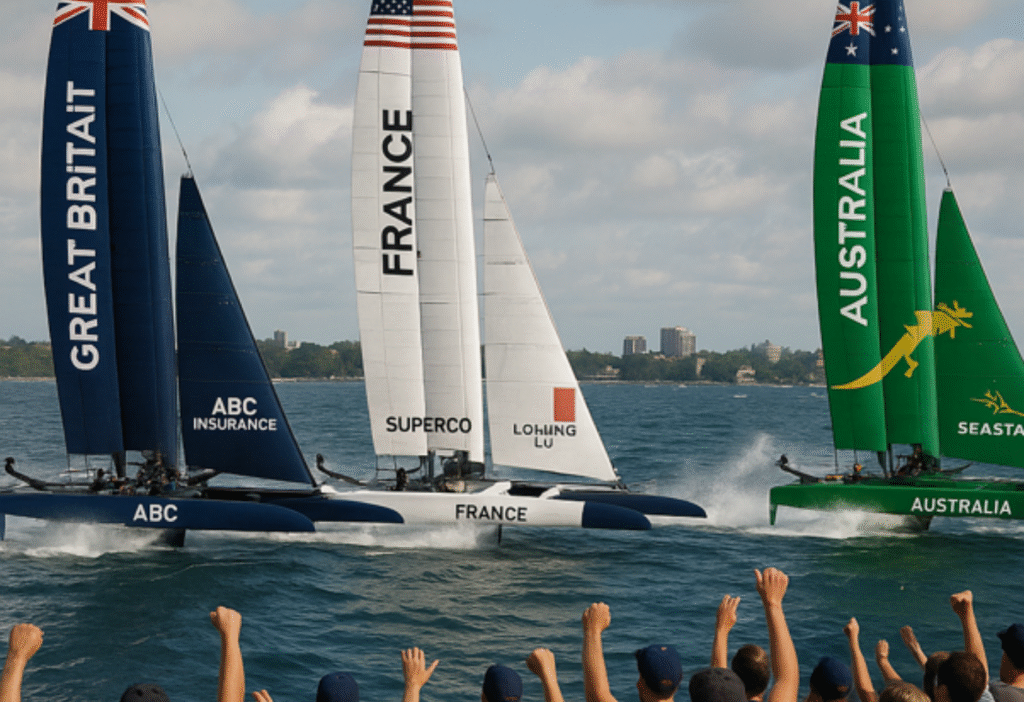
SailGP’s winning formula: The power of branding
An analysis of SailGP’s team model and why national identity, combined with sponsor branding, delivers value for fans and partners.
Platformation did a great job for MarkSetBot on this project. It really helped launch both our marketing and fundraising efforts. We highly recommend them!
Matthew Morin
A valuable partner offering constructive input and innovation from across the world of football and beyond.
Petr Zascherinsky
Platformation have provided great insight and recommendations across our broad, diverse portfolio of events and content.
Walter Böhm
Andrew’s experience and understanding of the field offered great confidence and the rigour they applied to such a complex challenge was best in class.
Fiona Fletcher-Smith
Andrew and his international network of suppliers delivered a comprehensive set of valuable insights.
Simon Thomas
Resourceful and skilled, with a fantastic network and incredible experience. A valued and trusted business partner.
David Sim
Our Services
We support organisations at different stages of the sponsorship lifecycle, from understanding value to applying insight in practice. Each service addresses a specific question, while together they provide a clear, connected view of sponsorship performance.